编译 | 李言
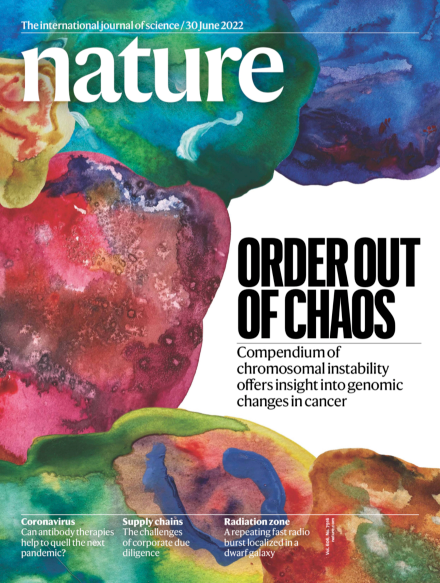
Nature, 30 June 2022, Volume 606 Issue 7916
《自然》2022年6月30日,第606卷,7916期
物理学Physics
Ordered and tunable Majorana-zero-mode lattice in naturally strained LiFeAs
锂铁砷中有序和可调控的马约拉纳零能模
作者:Meng Li, Geng Li, Lu Cao, Xingtai Zhou, Xiancheng Wang et al.
链接:
https://www.nature.com/articles/s41586-022-04744-8
摘要:
在此,我们通过扫描隧道显微镜/光谱学报告了在自然应变的化学计量LiFeAs(锂铁砷)中形成有序和可调控的马约拉纳零能模。我们在应变区观察到沿铁-铁和砷-砷方向的双轴电荷密度波(CDW)条纹。涡旋按砷-砷方向固定在CDW条纹上,形成有序的涡旋阵列。
我们发现,90%以上的涡旋是拓扑的,并且在涡旋中心具有马约拉纳零能模的特征,形成了一个有序的马约拉纳零能模阵列,其密度和几何形状可由外部磁场调节。值得注意的是,随着相邻涡旋间距的减小,多端面偶极子开始相互耦合。
我们的发现提供了一个有序和可调控的马约拉纳零能模阵列,为实现拓扑量子计算提供了重要的高质量研究平台。
Abstract:
Here we report the formation of an ordered and tunable MZM lattice in naturally strained stoichiometric LiFeAs by scanning tunnelling microscopy/spectroscopy. We observe biaxial charge density wave (CDW) stripes along the Fe–Fe and As–As directions in the strained regions. The vortices are pinned on the CDW stripes in the As–As direction and form an ordered lattice. We detect that more than 90 percent of the vortices are topological and possess the characteristics of isolated MZMs at the vortex centre, forming an ordered MZM lattice with the density and the geometry tunable by an external magnetic field. Notably, with decreasing the spacing of neighbouring vortices, the MZMs start to couple with each other. Our findings provide a pathway towards tunable and ordered MZM lattices as a platform for future topological quantum computation.
Axial Higgs mode detected by quantum pathway interference in RTe3
利用量子路径的干涉检测到RTe3中的轴向希格斯模式
作者:Yiping Wang, Ioannis Petrides, Grant McNamara et al.
链接:
https://www.nature.com/articles/s41586-022-04746-6
摘要:
在此,我们利用量子路径干涉,在电荷密度波(CDW)系统RTe3中发现了一个轴向希格斯模。在RTe3 (R = La, Gd)中,电子有序偶带为等角动量或不同角动量。
因此,与希格斯模相关的拉曼散射张量包含对称和反对称分量,它们通过两种不同但简并的途径激发。这导致了取决于入射光和拉曼散射光偏振选择的路径建设性或破坏性干涉。拉曼光谱的定性行为被一个适当的紧束缚模型(包括轴向希格斯模)捕获到。
反对称分量的阐明是希格斯模包含轴向矢量表示(即伪角动量)的直接证据,并暗示电荷密度波是非常规的。因此,我们提供了一种无需借助极端实验条件就能测量集体模量子特性的方法。
Abstract:
Here we discover an axial Higgs mode in the CDW system RTe3 using the interference of quantum pathways. In RTe3 (R = La, Gd), the electronic ordering couples bands of equal or different angular momenta. As such, the Raman scattering tensor associated with the Higgs mode contains both symmetric and antisymmetric components, which are excited via two distinct but degenerate pathways. This leads to constructive or destructive interference of these pathways, depending on the choice of the incident and Raman-scattered light polarization. The qualitative behaviour of the Raman spectra is well captured by an appropriate tight-binding model, including an axial Higgs mode. Elucidation of the antisymmetric component is direct evidence that the Higgs mode contains an axial vector representation (that is, a pseudo-angular momentum) and hints that the CDW is unconventional. Thus, we provide a means for measuring quantum properties of collective modes without resorting to extreme experimental conditions.
Fault-tolerant operation of a logical qubit in a diamond quantum processor
金刚石量子处理器中逻辑量子比特的容错操作
作者:M. H. Abobeih, Y. Wang, J. Randall, S. J. H. Loenen et al.
链接:
https://www.nature.com/articles/s41586-022-04819-6
摘要:
在此,我们使用金刚石量子处理器中的自旋量子比特演示逻辑量子比特上的容错操作。我们的方法是基于5个量子比特和一个最新发现的、可以使用7个量子比特实现容错的协议。
我们使用一种基于重复多量子位测量的新协议对逻辑量子位进行编码,并表明它优于非容错编码方案。然后,我们通过一组完整的单量子比特Clifford门对逻辑量子比特进行容错操作。
最后,我们演示了标记稳定器测量结果的实时处理。此类测量是容错量子纠错的基础。尽管未来在保真度和量子比特数量方面的改进将需要将逻辑错误率抑制在物理错误率以下,但我们在逻辑量子比特级别实现容错协议是朝着基于固态自旋的量子信息处理迈出的关键一步。
Abstract:
Here, we demonstrate fault-tolerant operations on a logical qubit using spin qubits in diamond. Our approach is based on the five-qubit code with a recently discovered flag protocol that enables fault tolerance using a total of seven qubits. We encode the logical qubit using a new protocol based on repeated multi-qubit measurements and show that it outperforms non-fault-tolerant encoding schemes. We then fault-tolerantly manipulate the logical qubit through a complete set of single-qubit Clifford gates. Finally, we demonstrate flagged stabilizer measurements with real-time processing of the outcomes. Such measurements are a primitive for fault-tolerant quantum error correction. Although future improvements in fidelity and the number of qubits will be required to suppress logical error rates below the physical error rates, our realization of fault-tolerant protocols on the logical-qubit level is a key step towards quantum information processing based on solid-state spins.
材料科学Material Science
Chiral molecular intercalation superlattices
手性分子插层超晶格材料
作者:Qi Qian, Huaying Ren, Jingyuan Zhou, Zhong Wan, Jingxuan Zhou et al.
链接:
https://www.nature.com/articles/s41586-022-04846-3
摘要:
在此,我们报告一种新型的手性分子插层超晶格材料(CMIS),它可以作为一种强大的固态手性材料平台来探索手性诱导的自旋选择性(CISS)。CMIS是通过插入二维层状晶体(2DACs)(如TaS2和TiS2)和选定的手性分子(如R-α-methylbenzylamine和S-α-methylbenzylamine)来制备的。
x射线衍射和透射电子显微镜研究表明,超晶格结构具有交变晶体原子层和自组装手性分子层。圆形二色性研究显示右手性和左手性CMIS之间有明显的手性依赖信号。
此外,通过使用得到的CMIS作为自旋滤波层,我们构筑了具有明显的手性依赖的自旋隧穿电子器件,实现了超过300%的自旋磁阻比和超过60%的自旋极化率。
Abstract:
Here we report a new class of chiral molecular intercalation superlattices (CMIS) as a robust solid-state chiral material platform for exploring CISS. The CMIS were prepared by intercalating layered two-dimensional atomic crystals (2DACs) (such as TaS2 and TiS2) with selected chiral molecules (such as R-α-methylbenzylamine and S-α-methylbenzylamine). The X-ray diffraction and transmission electron microscopy studies demonstrate highly ordered superlattice structures with alternating crystalline atomic layers and self-assembled chiral molecular layers. Circular dichroism studies show clear chirality-dependent signals between right-handed (R-) and left-handed (S-) CMIS. Furthermore, by using the resulting CMIS as the spin-filtering layer, we create spin-selective tunnelling junctions with a distinct chirality-dependent tunnelling current, achieving a tunnelling magnetoresistance ratio of more than 300 per cent and a spin polarization ratio of more than 60 per cent.
Hypocrystalline ceramic aerogels for thermal insulation at extreme conditions
极端条件下可用于隔热的次晶陶瓷气凝胶
作者:Jingran Guo, Shubin Fu, Yuanpeng Deng, Xiang Xu et al.
链接:
https://www.nature.com/articles/s41586-022-04784-0
摘要:
在此,我们报告一种锯齿状结构的亚晶锆石纳米纤维气凝胶,其在高温下具有异常的热机械稳定性和超低的热导率。
气凝胶具有接近于零的泊松比(3.3 × 10⁻⁴)和接近于零的热膨胀系数(1.2 × 10⁻⁷ /°C),这确保了优异的结构柔韧性和热机械性能。在剧烈的热冲击和高工作温度(高达1300摄氏度)下,他们展示了极低的强度退化(低于1%)和极高的热稳定性。
通过将残留的碳物质包裹在亚晶锆石纤维中,我们大大减少了热辐射传热,并实现了迄今为止陶瓷气凝胶中最低的高温导热系数之一,在1000摄氏度下为104 mW m-1 K -1。热机械和热绝缘性能的结合,为极端条件下的坚固隔热提供一个有吸引力的材料系统。
Abstract:
Here we report a multiscale design of hypocrystalline zircon nanofibrous aerogels with a zig-zag architecture that leads to exceptional thermomechanical stability and ultralow thermal conductivity at high temperatures. The aerogels show a near-zero Poisson’s ratio (3.3 × 10⁻⁴) and a near-zero thermal expansion coefficient (1.2 × 10⁻⁷ per degree Celsius), which ensures excellent structural flexibility and thermomechanical properties. They show high thermal stability with ultralow strength degradation (less than 1 per cent) after sharp thermal shocks, and a high working temperature (up to 1,300 degrees Celsius). By deliberately entrapping residue carbon species in the constituent hypocrystalline zircon fibres, we substantially reduce the thermal radiation heat transfer and achieve one of the lowest high-temperature thermal conductivities among ceramic aerogels so far—104 milliwatts per metre per kelvin at 1,000 degrees Celsius. The combined thermomechanical and thermal insulating properties offer an attractive material system for robust thermal insulation under extreme conditions.
地理学Geography
Intermittent lab earthquakes in dynamically weakening fault gouge
动态弱化断层泥中的间歇性实验室地震
作者:V. Rubino, N. Lapusta A. J. Rosakis
链接:
https://www.nature.com/articles/s41586-022-04749-3
摘要:
在此,通过实验室实验,我们发现自发传播的动态破裂通过复杂的、间歇性的滑移过程和剧烈的摩擦演化在带有细岩石断层泥的断层区域中导航。这包括在较低滑移率下摩擦加强导致的破裂扩展的反复停止,以及在与闪速加热一致的较高滑移率下摩擦显著快速减弱导致的动力地震重新成核。
细岩断层泥中摩擦的自发反复削弱和加强,突出了摩擦对滑移率和相关过程的基本依赖,如剪切加热、剪切的局部化和非局部化,以及剪切层的膨胀和压实。我们的发现扩大了对同震减弱可能使地震破裂突破稳定的断裂带这一概念的实验支持,这对研究地震危险性具有重大意义。
Abstract:
Here, using lab experiments, we show that spontaneously propagating dynamic ruptures navigate a fault region with fine rock gouge through complex, intermittent slip processes with dramatic friction evolution. These include repeated arrest of rupture propagation caused by friction strengthening at lower slip rates and dynamic earthquake re-nucleation enabled by pronounced rapid friction weakening at higher slip rates consistent with flash heating. The spontaneous repeated weakening and strengthening of friction in fine rock gouge highlights the fundamental dependence of friction on slip rate and associated processes, such as shear heating, localization and delocalization of shear, and dilation and compaction of the shear layer. Our findings expand experimental support of the concept that co-seismic weakening may enable earthquake rupture to break through stable fault regions, with substantial implications for seismic hazard.
编辑 | 方圆
排版 | 志海

合作事宜:hezuo@stimes.cn
投稿事宜:tougao@stimes.cn

喜欢本文?点赞 + 在看 支持一下!

| 留言与评论(共有 0 条评论) “” |